Resin patios get searched for two different reasons: people want ideas for how one could look, and they want to know whether the thing is actually any good before they spend on it. This guide does both, honestly. We lay resin patios for a living, so we will tell you where they genuinely shine and where they are the wrong call, rather than selling you the dream and skipping the small print.
The honest pros and cons (scan this first)
| Pros | Cons |
|---|---|
| Seamless: no joints to weed or rock | Only as good as the base underneath it |
| Grippy in the wet, broadcast anti-slip aggregate | Not a fix for a cracking or moving patio |
| Washes and brushes clean, moss does not soak in | Not a DIY job, it needs proper prep and a dry window |
| Colour that holds, UV-stable tones | Dearer than a tin of patio paint (and lasts far longer) |
| Laid over existing slabs, less mess and waste | Needs the surface to drain the right way already |
If your patio is structurally sound but tired, stained or uneven across the joints, a resin finish is one of the best upgrades going. If it is lifting, cracking or puddling, read the cons section before you spend a penny. First, the ideas.
What a resin patio actually is
Worth clearing up before the ideas, because the word resin covers two different outdoor surfaces. Most resin patios, and the ones we lay, are a resin coating bonded over the slabs you already have: we bond a continuous resin finish over the top of sound paving and broadcast a fine aggregate into it for grip, so you end up with one smooth, seamless surface instead of a grid of slabs. The other kind is resin-bound stone, a permeable aggregate surface laid from scratch, which is what most people picture for a resin driveway. For an existing patio the coating is usually the right tool; our outdoor resin flooring page weighs up which external surfaces suit a coating and which do not.
Resin patio ideas
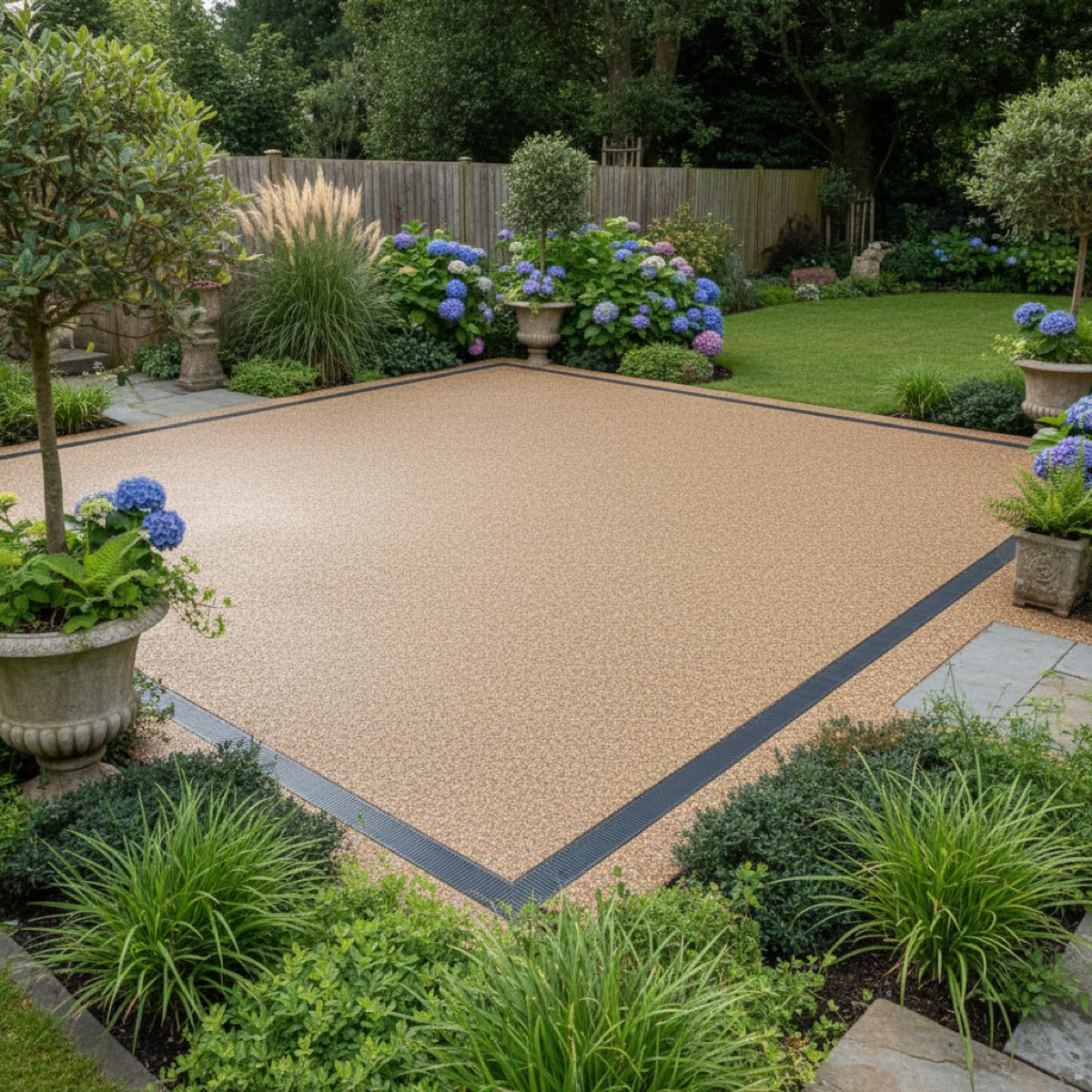
Because the finish is mixed and laid to order, a resin patio is one of the more flexible surfaces to design around. The ideas worth stealing:
- Match the house, not the catalogue. Natural stone tones, warm greys and buff blends sit comfortably against brick and render; bolder colours work where the planting and furniture carry it.
- Run it seamless across the whole area. The big visual win is losing the joint lines, so a single tone flowing wall to wall reads far calmer than a patterned slab layout.
- Carry it up the steps and the porch. Taking the same finish over steps and a porch threshold ties the back of the house together and kills the trip-edge between levels.
- Use a border or a contrast band. A darker margin around the edge, or a band where the patio meets the lawn, frames the space without adding joints.
- Coordinate with the drive. Picking a patio tone that talks to the driveway surface pulls the whole plot together from the front gate to the back fence.
- Think about gloss level. A satin finish hides marks and stays grippy; a higher sheen lifts the colour but shows more. We talk this through in our guide to choosing a resin floor colour and finish.
A tip before you choose a colour
Thinking about a resin patio?
Tell us the rough size, what is down now and the look you are after. We will tell you straight whether your base suits it and put a fixed price in writing, no pressure either way.
The pros: why people choose a resin patio
The headline reason is the joints, or rather the lack of them. A traditional slabbed patio weeds up between every slab, the slabs rock and lift as the ground moves, and the joints trip you and trap dirt. A resin finish is continuous, so there is nothing to weed, nothing to rock and nothing to catch a chair leg. The broadcast aggregate keeps it grippy in the wet and through a frost, while the surface still brushes and hoses clean instead of letting moss and spills soak into porous stone. The colour is built into a UV-stable finish, so a patio that suits a north-facing garden in January still suits it in July, and because we lay it over your existing slabs there is far less mess, waste and skip-hire than ripping the whole thing out.
The cons: where resin patios fall short
Now the honest part. A resin patio is a skin over what is already there, so it inherits the base. If your slabs are cracking, lifting or moving, those problems come back up through the resin; if the patio puddles or slopes back towards the house, a coating does not fix the drainage. We will tell you when the base is past it and needs sorting first, rather than skinning over a problem to win the job. It also is not a DIY surface: it needs the existing patio properly cleaned and prepped, the right resin for an outdoor British climate, and a dry weather window to cure, which is why a botched self-attempt usually peels. And it costs more than a tin of patio paint. It also lasts vastly longer and does not flake off after a winter, but if your budget genuinely only stretches to paint, that is worth knowing up front.
Are resin patios any good? Who they suit
For the right patio, they are excellent. A resin patio suits you if your paving is structurally sound but tired, stained or uneven, you are sick of weeding joints and rocking slabs, and you want a clean, modern, low-maintenance finish that holds its colour. It does not suit you if the base is failing, the area does not drain, or you are chasing the cheapest possible quick fix. In short: it is a brilliant upgrade for a sound patio and a waste of money on a broken one. Looked after, it is about as low-maintenance as outdoor surfaces get, an occasional wash being most of it, much like the routine in our guide to cleaning and maintaining a resin floor.
Can you lay a resin patio yourself?
Honestly, it is not one we would point a DIYer at. The result lives or dies on the prep, getting the existing surface clean, sound and dry, on choosing a resin that copes with UV and the wet, and on laying and broadcasting the aggregate evenly before it goes off. Get any of those wrong and it peels, patches or goes slippery. Kits exist, but the common ending is paying twice: once for the kit, once to have a botched attempt taken up and done properly.
About this guide
Who wrote this
This guide is written by the Obsidian Resin team. We lay resin patios and outdoor surfaces across Leicestershire, so the pros and cons here are the ones we actually talk customers through on site, not a list lifted from a brochure.
Our honest position
We have a commercial interest in laying your patio and we are upfront about that. It is also why we would rather tell you when your base is not up to it than take the job and watch the finish fail, because a patio that lifts is no advert for us.
Frequently asked questions
- Are resin patios any good?
- For a sound patio, yes, they are one of the best upgrades available: seamless with no joints to weed, grippy in the wet, easy to clean and colour-stable. They are a poor choice only where the base is cracking, moving or holding water, because a resin finish follows whatever is underneath it.
- How much does a resin patio cost?
- There is no single price per square metre, because the cost is driven by the area, the condition of the slabs underneath, the finish and access. We quote each patio as one fixed price after we have seen it. Our cost guide explains the drivers in full.
- Can I lay a resin patio myself?
- We would not recommend it. The finish depends on proper prep, the right outdoor resin and a dry cure window, and DIY attempts commonly peel or go slippery, which means paying again to put it right.
- Can you resin over an existing patio?
- Yes, and that is how most resin patios are done: a resin finish bonded over sound existing slabs with anti-slip aggregate broadcast in. The slabs need to be structurally sound and draining correctly first; if they are lifting or puddling, that has to be sorted before any resin goes down.
- Do resin patios get slippery when it rains?
- Not when they are laid properly. A fine anti-slip aggregate is broadcast into the resin, giving a grippy texture that stays safe in rain and frost while still brushing clean.