Resin and block paving are the two finishes most people weigh up for a new driveway, and both can look excellent. The honest difference is not which looks better on day one, it is how they behave over the years and what you end up doing to keep them tidy. Here is how a resin-bound driveway compares with block paving, including where block paving genuinely wins. If tarmac is also on your shortlist, we compare resin and tarmac separately.
The quick comparison (scan this first)
| Resin-bound driveway | Block paving | |
|---|---|---|
| Surface | One seamless poured surface | Individual blocks on a sand bed |
| Joints and weeds | No joints, nothing to weed | Weeds and moss grow in the joints |
| Permeable (drains through) | Yes | Only with permeable blocks and the right sub-base |
| Sinking and movement | Bonded to a solid base, stays flat | Blocks can sink, lift or rut over time |
| Upkeep | Occasional wash down | Weeding, re-sanding joints, resetting the odd block |
| Spot repair | Patch is possible but blends less neatly | Lift and relay individual blocks |
| Look | Smooth, modern, wide colour range | Traditional, patterned, many block styles |
For most driveways that table leans towards resin-bound on upkeep and drainage, while block paving keeps one real advantage on repairs. Here is why each behaves the way it does.
Weeds and joints: the everyday difference
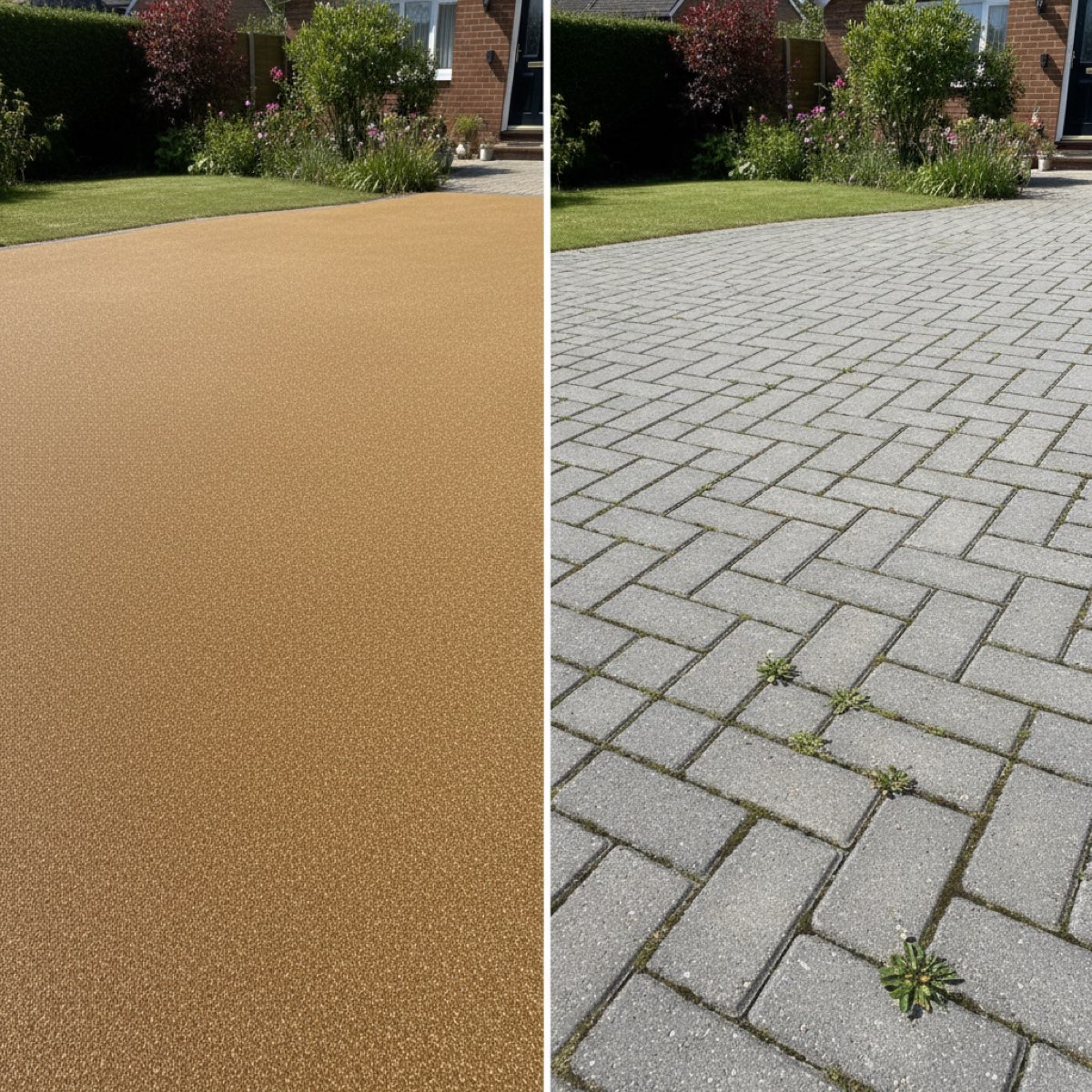
Block paving is made of hundreds of separate blocks with a sand-filled joint between every one. Those joints are where the maintenance lives. Weeds and moss seed into them, the jointing sand washes and blows out over time and needs topping up, and the more the joints open the more they let growth through. None of it is difficult, but it is a recurring job. A resin-bound surface has no joints at all: the stones are bound together into one continuous skin, so there is nowhere for a weed to root. That single fact is the reason most people who switch from block paving to resin say the driveway suddenly looks after itself.
Movement and sinking
Block paving sits on a compacted sub-base and a sand bed, held in place by an edge restraint. On a well-built driveway it stays put for years, but where the base was rushed or the ground moves, individual blocks can sink, tilt or rut, most often in the two tracks where car wheels run. Resin-bound is trowelled onto a sound, bound base and cures into one rigid surface, so it cannot shuffle out of line block by block. Both stand or fall on the base beneath them, but resin has no individual units to work loose.
Permeability and drainage rules
This is the practical one for a front garden. A resin-bound surface is permeable, so rain soaks through it into the ground rather than running off into the road or a drain. That makes it straightforward to lay within the UK drainage guidance for front gardens. Here is the catch most people miss: standard block paving is not permeable. Water runs off it. To be compliant you need purpose-built permeable block paving, which is a different, dearer system with wider joints filled with a clean grit, laid over an open-graded sub-base so water can drain through the gaps. Ordinary block paving over a certain size needs planning permission or a drainage plan; resin-bound sidesteps that as standard. We cover the rules in our guide to planning permission for a resin driveway.
One surface vs many blocks
Weighing up a new driveway?
Tell us the rough size and what is down now, block paving, tarmac or bare ground. We will tell you honestly whether resin suits the job and put it in a fixed-price written quote.
Repairs: block paving's real advantage
This is where block paving earns its keep. Because it is made of separate blocks, a damaged or stained one can be lifted and swapped, and if a utility company has to dig a trench across the drive, the blocks can be lifted and relaid afterwards. A resin-bound surface can be patch repaired, but a fresh patch is harder to blend perfectly into weathered surrounding resin. If you expect to be lifting the surface, for a soakaway, a future extension or known underground services, that flexibility is a genuine point in block paving's favour, and we will say so rather than pretend otherwise.
Look and finish
This one is down to taste. Block paving gives you a traditional, patterned look with a huge range of block shapes, colours and laying patterns, from classic herringbone to modern large-format setts. Resin-bound gives a smooth, contemporary finish in a wide range of aggregate blends and colours, with no pattern lines breaking it up. If you want a period or heavily patterned look, block paving has more options; if you want clean and seamless, resin does that better.
Longevity
Both are long-lived when laid properly on a sound base. Block paving typically lasts around 20 to 30 years, though expect to re-sand the joints with kiln-dried sand and reset the odd sunken block along the way; a resin-bound driveway typically lasts around 15 to 25 years with little more than the occasional wash and no re-sanding, as we set out in our guide to how long a resin driveway lasts. Block paving edges ahead on outright lifespan, resin-bound on how little you have to do to it. With either surface the base and the workmanship decide the lifespan far more than the finish on top.
Cost
There is no single price for either; the real cost is driven by the area, the condition and type of the base, and access, the same factors we set out in our cost guide. Block paving is labour-intensive to lay block by block, while resin needs a sound base to be trowelled onto, which is often the biggest single item on a driveway quote. Rather than quote a misleading rate per square metre, we price each driveway once we have seen the size and what is underneath.
So which should you choose?
Choose a resin-bound driveway when:
- You want a low-maintenance, weed-free surface with no joints to re-sand.
- You want it permeable, with no puddles and easier drainage compliance.
- You want a smooth, seamless, modern finish.
Consider block paving when:
- You want to be able to lift and relay sections yourself, or expect to dig up the drive.
- You want a traditional, patterned look or a specific block style.
About this guide
Who wrote this
This guide is written by the Obsidian Resin team. We lay resin-bound driveways across Leicestershire, and a good share of them go over the top of a sound base where tired, weedy block paving used to be, so we see how block paving ages up close.
Our honest position
We have a commercial interest in laying your driveway and we are upfront about that. For most driveways we think resin-bound is the easier surface to live with, but where you value lift-and-relay repairs or a heavily patterned look, block paving is a fair choice and we will tell you so.
Frequently asked questions
- Is a resin driveway better than block paving?
- For low upkeep and drainage, yes: resin-bound is seamless, permeable and weed-free, with no joints to re-sand. Block paving keeps one real edge, you can lift and relay individual blocks, which matters if you expect to dig up the drive.
- Do resin driveways get weeds like block paving?
- No. A resin-bound surface has no joints for weeds to root in, so it does not weed the way block paving does. Block paving grows weeds and moss in its sand-filled joints unless they are kept topped up and treated.
- Which lasts longer, resin or block paving?
- Both last many years on a sound base. Block paving may need occasional resetting and re-sanding; resin-bound needs little more than a wash. The base and the workmanship decide the lifespan far more than the surface itself.
- Can you lay a resin driveway over existing block paving?
- Sometimes, if the block paving is sound, flat and well-drained it can act as a base; more often the blocks are lifted or a new bound base is laid so the resin has a solid, stable surface underneath. We check the existing driveway before advising either way.
- Is resin cheaper than block paving?
- Neither has a fixed price. Both are driven by the area, the base and access rather than a simple rate per square metre. We give a single fixed written price once we have seen the driveway.