One letter apart, and people use the names interchangeably, but resin-bound and resin-bonded are genuinely different surfaces that behave differently and suit different jobs. If you are pricing up a driveway it is worth knowing which is which before anyone quotes you, because the smooth, permeable driveway most people have in mind is only one of the two. Here is the difference, plainly.
The quick comparison (scan this first)
| Resin-bound | Resin-bonded | |
|---|---|---|
| How it is laid | Stone and resin mixed, then trowelled | Resin coat, then loose stone scattered on |
| Surface | Smooth and flat | Textured, like coarse sandpaper |
| Loose stones | None | Sheds some stone over time |
| Permeable (water drains through) | Yes | No, water runs off |
| SuDS friendly | Yes, usually | No |
| Best for | Driveways, paths, patios | Ramps, steps, grippy commercial areas |
| Look | Premium, smooth, modern | Rougher, traditional texture |
For most driveways that table settles it in favour of resin-bound. Here is why each behaves the way it does.
What resin-bound is
Resin-bound is the one most people picture when they imagine a resin driveway. The aggregate and the resin are mixed together in a forced-action mixer, then the whole mix is trowelled out by hand to a smooth, flat surface over a sound base. Because the stones are fully coated and bound throughout, there are no loose stones to kick up, scatter or track into the house. And because it is laid with tiny gaps between the bound stones, water drains straight through it rather than pooling on top. That permeability is what makes it the modern choice for driveways: no puddles, no standing water, and far easier to satisfy drainage rules.
What resin-bonded is
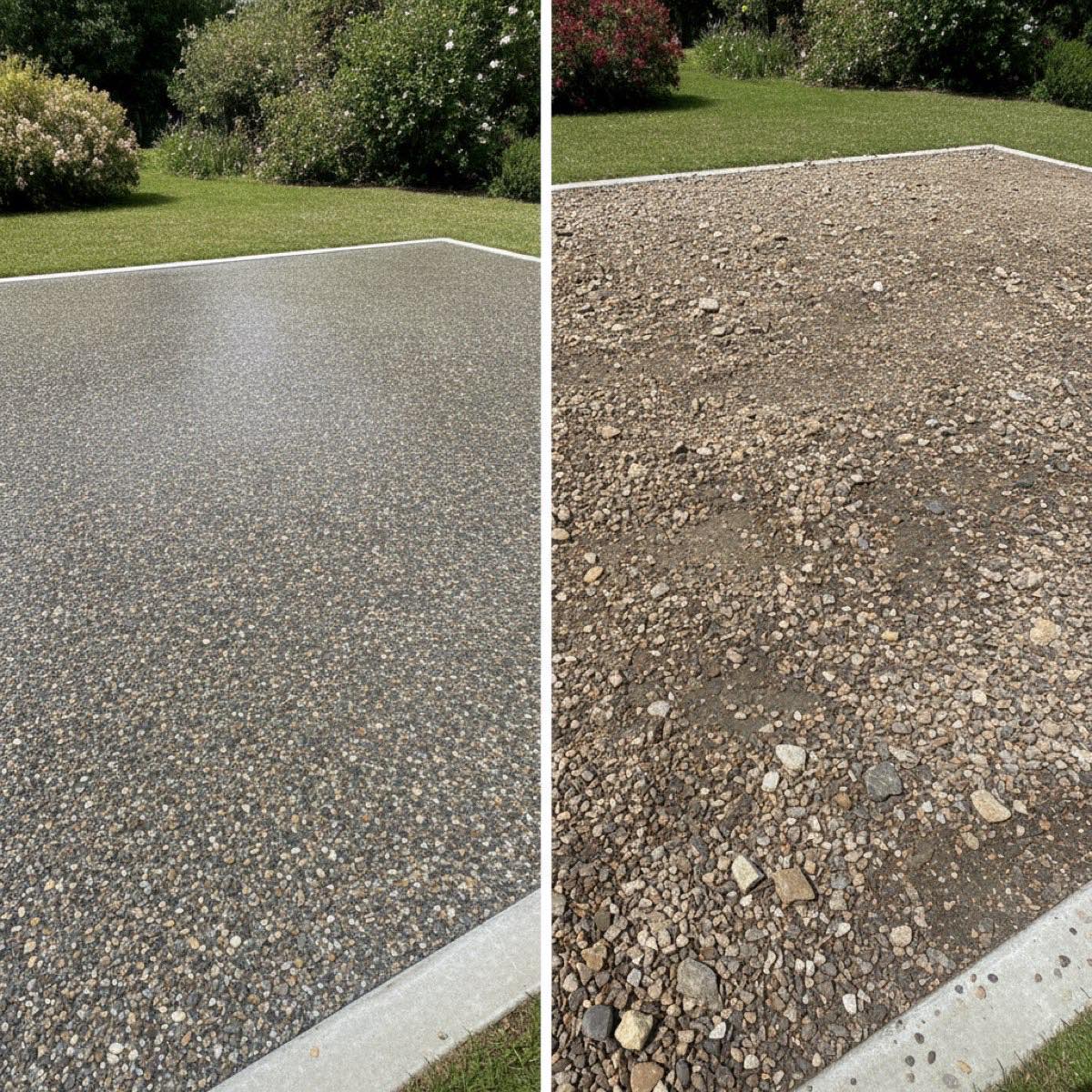
Resin-bonded is a different method that gives a different result. A coat of resin is applied to the base, and then loose stone is scattered (broadcast) onto the wet resin so it sticks to the surface. Only the bottom of each stone is held, so the finished surface is textured and rough, like very coarse sandpaper. It is not permeable, so water runs off it rather than through it, and because the stone is only surface-bonded, some of it works loose over time. That texture is genuinely useful where grip matters, on a ramp or a sloped commercial approach, but it is rarely what someone wants underfoot on a smart driveway.
The names, decoded
Permeability and drainage rules
This is the practical difference that matters most for a driveway. A resin-bound surface is permeable, so rainwater soaks through it into the base below instead of running off into the road or your drains. That is not just tidier; it makes the driveway far easier to lay within UK drainage guidance for front gardens. A resin-bonded surface is not permeable, so on a larger area you may need to plan where the run-off goes. We cover this in more detail in our guide to planning permission for a resin driveway.
Loose stone and maintenance
Resin-bound sheds no loose stone, so there is nothing to sweep off the path, track indoors or clog a mower. It is about as low-maintenance as a driveway gets: an occasional wash down. A resin-bonded surface releases some stone over its life, especially early on, which means a bit of sweeping and the odd top-up. Neither is high-maintenance, but resin-bound is the cleaner-living of the two, and looked after either way a resin driveway has a long life, as we set out in our guide to how long a resin driveway lasts.
Planning a resin driveway?
Tell us the rough size and what is down now. We will tell you which system suits the job and put it in a fixed-price written quote.
Grip and safety
Resin-bonded's one clear advantage is grip. The rough, broadcast texture gives excellent traction, which is why it earns its keep on ramps, steps and sloped approaches. Resin-bound is by no means slippery, and we can build extra grip into it where needed, but if maximum traction on a steep slope is the priority, resin-bonded has the edge. For a normal, reasonably level driveway, that advantage rarely comes into play.
Cost
The two are broadly comparable per square metre, with the real price driven by area, the condition and type of the base, and access, the same factors we set out in our cost guide. The base matters especially: resin surfacing needs a sound, suitable base underneath, and preparing or laying one is often the biggest single item on a driveway quote.
So which should you choose?
For a driveway, paths or a patio, choose resin-bound when:
- You want a smooth, flat, premium finish.
- You want it permeable, with no puddles and easier drainage compliance.
- You do not want loose stones tracked into the house.
Consider resin-bonded only when:
- Maximum grip on a ramp or steep slope is the priority.
- You specifically want a rough, textured, traditional surface.
About this guide
Who wrote this
This guide is written by the Obsidian Resin team. We lay resin-bound driveways across Leicestershire, and the bound-versus-bonded mix-up is one of the most common things we have to clear up when someone has been quoted by more than one firm using the words loosely.
Our honest position
We have a commercial interest in laying your driveway and we are upfront about that. We are not steering you towards the dearer option; for most driveways resin-bound is simply the right surface, and where resin-bonded genuinely suits the job, we will say so.
Frequently asked questions
- What is the difference between resin-bound and resin-bonded?
- Resin-bound mixes the stone and resin together and is trowelled smooth and permeable. Resin-bonded scatters loose stone onto a resin coat for a rough, textured, non-permeable finish that sheds some stone over time.
- Which is better for a driveway?
- For almost all driveways, resin-bound: it is smooth, permeable, puddle-free, has no loose stones and is easier to satisfy drainage rules. Resin-bonded is better kept for ramps and grippy slopes.
- Is resin-bound permeable?
- Yes. Water drains through it into the base below, which is why it is the go-to for front-garden driveways under UK drainage guidance. Resin-bonded is not permeable.
- Do resin driveways get loose stones?
- Resin-bound does not; the stone is bound throughout. Resin-bonded releases some surface stone over time, particularly in its first months.
- Are they similar in price?
- Broadly, yes. The real cost is driven by the area, the base it is laid on and access, rather than which of the two systems you choose.